Refreshing Ruth


But Ruth said, “Do not urge me to leave you or turn back from following you; for where you go, I will go, and where you lodge, I will lodge. Your people shall be my people, and your God, my God. “Where you die, I will die, and there I will be buried. Thus may the LORD do to me, and worse, if anything but death parts you and me.”
Ruth 1:16, 17

What an oasis is the Book of Ruth after the death valley days of the Book of Judges which depicts Israel falling further from grace embracing idolatry on a more regular basis. Judges is not a delightful read. Yes, our Lord proves over and over that He is gracious and compassionate. But it is with an almost overwhelming sadness we read that God’s chosen people keep rejecting Him and the goodness He promises preferring to give themselves over to worthless inanimate objects of idolatry. After reading Judges we welcome the fresh air of Ruth, proving that even though the nation and leadership was Hell bent, there were individuals who maintained the hope that was promised.

It is interesting that out of all the people of Israel it is a foreigner that is selected by God to continue the line of the promised seed which lead through King David down to Mary and Joseph and their son Jesus, the Messiah. This further validates the grafting in of the wild olive branch that Paul mentions in Romans 11:24, 25, and the other nation the prophets indicated that God was going to call into His fold. (Is. 55:5; Is. 65:1) No one it seems is beyond the reach of the awesome arm of the Lord.

The small Book of Ruth is a charming story of some good people who loved God and their nation and lived honorably. Not dependent on the life she was used to in Moab, not clinging to her own people and way of life and culture, she recognized something greater in Naomi and her family. That must have been quite a witness, but Ruth had a heart to see it while Orpah did not. It is extremely difficult to see beyond one’s own comfort level, look beyond the horizons that make up your world, and see things that are not granted to most. Ruth saw and it changed her life dramatically. It is especially difficult in the midst of heartbreaking circumstances as the death of most of your loved ones. But if one is careful enough to listen the call of God’s grace may be heard.

Another interesting point is that Boaz lived in Bethlehem, which is where his descendants Mary and Joseph must return for the census of Caesar Augustus, required to return to their ancestral home. This is further confirmation of the prophets mentioning the Messiah was to come from this town. (Micah 5:2)

I recommend reading this book in one sitting. That’s easily accomplished since its only four chapters long. Its a sweet story, a feel good story, love and devotion conquers all and becomes a blessing to boot! And as you read through Judges, Ruth, and Samuel, it is a refreshing break between some painful events in the life and death of the nation of Israel.

[Scriptures taken from the New American Standard Bible © 1995]

Posted in Dedication | Tagged , , , | Comments Off on Refreshing Ruth

“What The Bible Teaches,” R.A. Torrey – a Discussion

At the open invitation of Lex – TheEstherProject.com, I’ll join in posts related to the R. A. Torrey publication “What the Bible Teaches,” printed in 1898 by Fleming H. Revell Company (now in the public domain). (See Torrey’s brief bio here.) Myself being partial to 19th century books about God and the Bible (like the Kiel & Delitzsch commentaries on the Old Testament, Phillip Schaff’s 8 volume History of the Christian Church, as well as even older publications like John Calvin’s Institutes of the Christian Religion), there is great refreshment and spiritual nourishment found in these “ancient” publications, simply because the authors are obviously exceptionally gifted writers devoted to the glory of God and His Word with a phenomenal wealth of learning dripping from their pens. I confess I am less conversant with contemporary writers but there is only so much time!

Prior to this book I’ve not read any RA Torrey, but skimming these pages shows me the author has objectives identical to those referenced above. Expound God’s Word in a manner that is faithful to the text, edify the reader, and bring glory to God rather than men. Whether my own reflections on the chapters (there are 53 of them) does justice to those objectives is to be seen. I have no illusions of my capabilities but this is my hope. Lex and I have decided to split the chores writing every other week with Lex starting this Thursday March 1.

A note on the book itself before plunging into this commitment. Published in 1898 Torrey states in the Preface that his book

“is based on a careful study of the original text as decided by the best textual critics (especially Tischendorf and Westcott and Hort in the New Testament, though other editors, and the manuscripts themselves have been considered in some instances). Wherever possible the text of the Authorized Version has been given. In many instances this was impossible, as the Revised Version is manifestly much more exact. Had it appeared that the Revised Version would soon obtain that general acceptance and use which it seems to so richly deserve, the author would have adopted it throughout, except in those rare instances where it is manifestly in error. In a few instances, it was necessary to adopt renderings differing from both the Authorized Version and the Revised Version, and from the American Appendix to the Revised Version.”

Desiring not to enter any flame wars it should be admitted that translations available now in 2012 are of surpassing value in assisting a meaningful study of the Scriptures, textual criticism marching so much further in the past hundred and fourteen years. I personally find more satisfaction using a more accurate version of the Scriptures like the New American Standard (NASB) to facilitate my understanding of the text of the Old and New Testaments and the message God intended to impart, as the NASB and other recent translations are just so much more readable; and it should go without saying that having an accurate biblical text is better than having a copy prone to errors of translation. But ultimately there is no impediment to understanding God’s Word if you use an older translation. It may take a bit more work, but will still be profitable if one has ears to hear. I’m glad to read that Torrey himself was just so concerned with reading an accurate biblical text.

A free copy of What the Bible Teaches can be downloaded at these links: a facsimile copy of the 1898 publication, and a more readable version of the same text with some updates.

What the Bible Teaches can be loosely described as a primer on Christian doctrine, much as Calvin’s Institutes are, though Calvin is mightily verbose, where Torrey is brief and concise. Torrey posits a belief then a list of Scriptures follows in support. The book is divided into six books: what the Bible teaches about God, Jesus Christ, the Holy Spirit, Man, Angels, and the Devil. Torrey summarizes:

“THE AIM OF THIS BOOK is to ascertain and state in systematic form what the Bible teaches. The method pursued will be to first give the Scripture statements, and then summarize their contents in a proposition, following the proposition with comments when necessary.”

So with that Lex will begin book one, WHAT THE BIBLE TEACHES ABOUT GOD. 1. GOD AS SPIRIT. We hope this will stimulate abundant comments and conversation following each post, concerning God, His Word, and our life in His creation. That should encompass about everything!

To the glory of God.

Posted in What the Bible Teaches | Tagged , , , | 1 Comment

Judging Judges


In those days there was no king in Israel; everyone did what was right in his own eyes
Judges 21:25

The seventh book of the Bible describes the path of God’s chosen people in their decent towards dissolution. After 400 years of enslavement in Egypt the glorious hand of God frees them in awesome ways as He guides them personally towards Canaan and the fulfillment of His promise to Abraham, Isaac, and Jacob. In spite of the failures along the way of Israel to stay true and focused on God’s greatness and instead falling away time after time the nation is led by Moses up to, and then by Joshua across the river Jordan.

By the time we get to the Book of Judges Israel has been in the land for a while and has settled by their tribes to a great extent and is ready for the fulfillment of the sweet promises of blessing. But Joshua is dead and so it seems is their cohesion without a leader. Falling prey to the surrounding nations everyone does what is right in their own eyes; no longer looking to God as their head it is every man for himself. The result is God’s promised judgement for abandoning Him. Instead of ruling over and removing the remaining nations as instructed, Israel again is enslaved. But even though His people abandon Him, He does not abandon them. Every so often, when Israel’s misery becomes unbearable, the Lord raises up a judge to lead them back to independence from those nations and dependence on God.

There are great stories of bravery and conquest by the likes of Deborah and Gideon. And at times judges are used in spite of personal failures and lack of discernment like Samson and Jephthah. But God uses whom He will for His own purpose. It isn’t He who depends on man, it is the opposite. And in spite of the continuous failure of people to grasp the gift of life when it is freely offered, God never gives up.

It is of little surprise then even as mankind exhibits moments of brilliance (we are after all made in God’s image) the propensity for depravity is overwhelming. Just look at any newspaper with headlines about the latest genocide in Syria, and continued escalation of violence towards impending disaster in Iraq and Afghanistan, and the rest of the manifestations of evil much closer to home. No wonder God told Moses He’d wipe out His chosen race. (Deut. 9:14, 32:26 ff.) But God’s redemptive plan grinds on as we continue reading through the Scriptures as shortly the glorious development in the nation of Israel blooms in the kingdoms of David and his son Solomon. And it is that blossoming we can’t forget about in the midst of all the misery in the Promised Land, redemption is coming. You better be prepared.

[Scriptures taken from the New American Standard Bible © 1995]

Posted in judgement | Tagged , , , , | Comments Off on Judging Judges

Translating a Translation, the King James Version


Be diligent to present yourself approved to God as a workman who does not need to be ashamed, accurately handling the word of truth.
2 Timothy 2:15

I am baffled, amused, and dismayed by the polemics surrounding the King James translation of the Bible. Published in 1611 its 500th anniversary was celebrated last year. I find myself astonished at the tenor of some extreme views of this venerable version. That there can be reasoning individuals believing there is no other legitimate Bible to use that the Authorized Version is astounding.

It can’t be denied that if no other translation of the Word of God is available to you that the use of the KJV can be appreciated. An honorable group of individuals are responsible for crafting a translation, which for its time, was an improvement over the then vernacular edition, the Geneva Bible, on which the KJV was based. The history of its beginning in the first years of the 17th century makes fascinating reading, how the newly installed King of England in 1604, James I, facilitated its development. It is not that there was lacking a version of the Bible in the English language, but the Puritans wanted an updated version that was not so much influenced by Catholic beliefs.

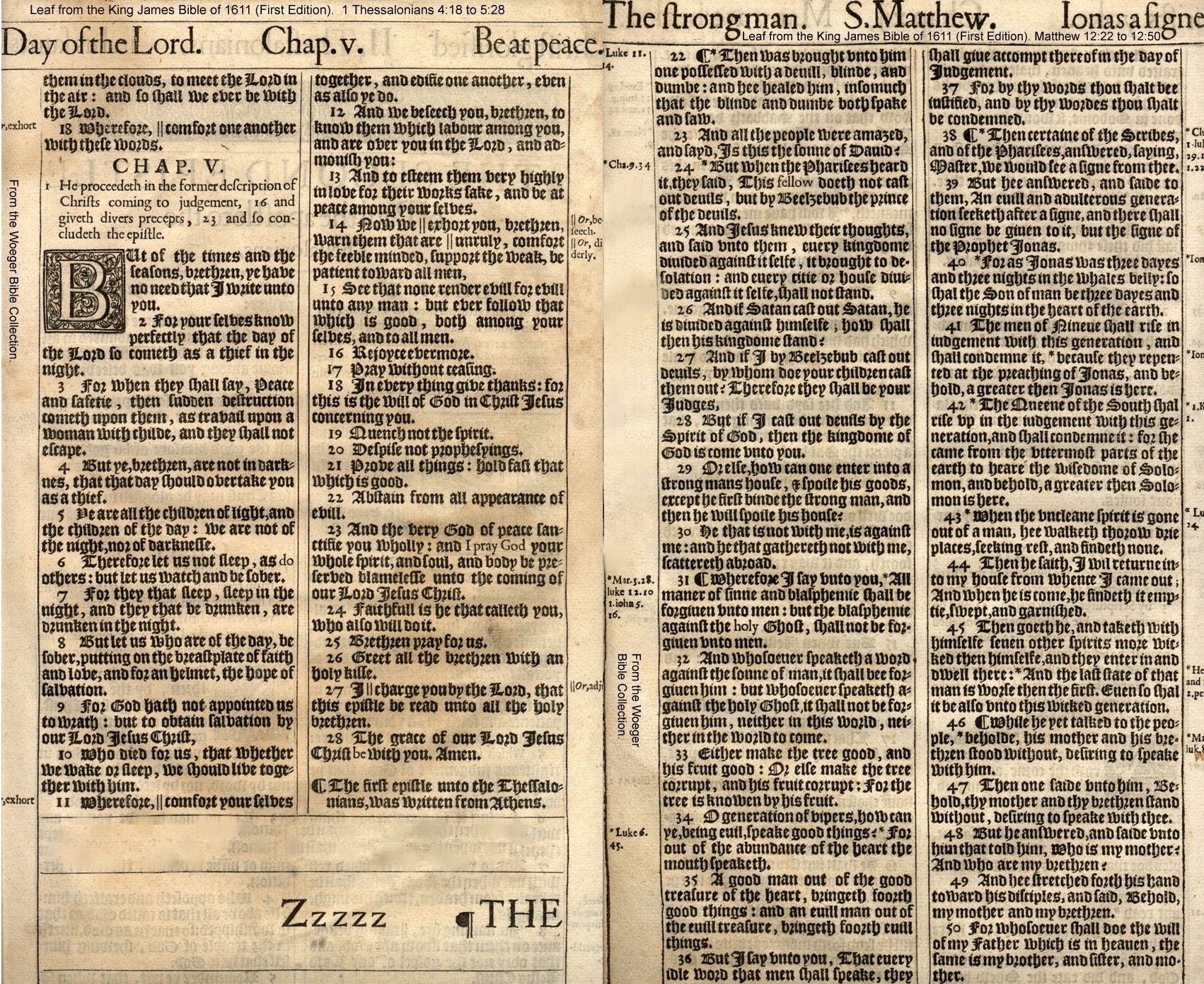
Moving forward 500 years, the English language has changed much from that of Puritan England. Spelling, word usage, and syntax has changed dramatically. It takes a great deal of effort today to read from the pages of the original publication of 1611. from the 16111 publication

And that brings us to the two main reasons for desiring a new translation of the Scriptures. The exercise of reading has one objective, to understand the presented text. It is of very little profit to read something and not understand it. Accuracy and readability are fundamental objective of the science of translation. The translation team hopes the results of their work will reveal the intended meaning of the original author. They strive to piece together all known fragments of the text to arrive as close as possible to the text precisely as penned. The school of Textual Criticism is devoted to this very question. The reward of delving into the world of textual criticism is the comfort of certainty that the parchments, fragments, and ancient copies of Scripture lead us as close to those originals as we will ever get.

But there are those who have taken the veneration of the “Authorized” version to the extreme. There is a “KJV Only” camp and there is a “1611 version KJV Only” camp, and they ferociously maintain their position. They are diehard fans of the KJV who honestly believe this version is the only accurate version and condemn the use and users of any other. And the sub-camp actually claims that only the text published in 1611 is the sole legitimate version. Just do a Google search on King James Bible defended and you will be amazed at the proliferation of this view. As one web site states, “As Bible-believing Christians, we believe that the words of the King James Authorized Version are the pure and preserved words of God for the English speaking people.” Another claims “The Holy Spirit came to the defense of the KJV … We have uncovered this historic truth: Jesus protected the text of the KJV!”

It can hardly be denied that ANY translation of the Bible has its imperfections and that there are degrees of accuracy of translation and of readability between versions. But they are at best translations of the original documents. And even the originals are not things to be substituted for the living God, idolatry is condemned in all its forms. It is not the translations and copies of the original books of the Bible that are to be worshiped, it is solely the living Word that demands our adoration. Even a cursory reading of the Old Testament reveals that it is one’s living relationship with God that is paramount, not the blind fulfilling of rites and ceremonies. (See Micah 6:7-8) It is righteous behavior that God requires, not reverence by rote. So it is puzzling that there are those whose priority in reading and studying God’s word is adhering to a particular translation rather than comprehending His Word as fully as possible.

I can’t help but think that it is a Believer’s objective, even responsibility, to read from the most accurate and readable translation of the Bible as one can afford and acquire. And these days there are many versions that fill that bill in the English vernacular. Indeed, there are versions to be avoided, such as those that come from such sectarian groups like the Mormon Church, and Jehovah’s Witnesses (The New World Translation), whose translations are oriented and influenced by errors in their theology and understanding who Jesus Christ really is. Though even in these relatively inaccurate translation God can reach the human heart if it is so inclined.

The point it that one who has been born again to a new life in Christ, who is chosen by grace into a personal relationship of the living God should naturally crave the most deep and fulfilling comprehension of this God who is there and is not silent. How can such a child of God not want to understand everything that has been revealed about Him? And nowhere else has He shared with His creation the deep things of God. Evidence of God and His power and nature are certainly shown through the creation (Romans 1:20) but it is only through the word of the Gospel that the path of salvation lies. And we are compelled to accurately handle that word.

Resources:

  • January 17, 1604 The King James “Authorized Version”
    A brief history of the Authorized Version.
  • The Authorized Version (1611)
    “taken from the article ‘English Versions’ by Sir Frederic G. Kenyon in the Dictionary of the Bible edited by James Hastings, and published by Charles Scribner’s Sons of New York in 1909.”
  • Bible Research, Internet Resources for Students of Scripture
    “for Bible students who are looking for detailed information on the history of the canon, texts, and versions of Scripture”
  • So Many Versions 20th Century English Versions of the English Bible, Revised & Enlarged Edition
    by Sakae Kubo & Walter F. Sprecht, Zondervan, , 1983
    A well written, balanced, evaluation of the major current Bible versions
  • Posted in Translations | Tagged , , , , , | Comments Off on Translating a Translation, the King James Version

    Secret Things


    The secret things belong to the LORD our God, but the things revealed belong to us and to our sons forever, that we may observe all the words of this law.
    Deuteronomy 29:29

    These days I occasionally visit christianpost.com to read about current events and opinions on their blogs. As the name implies this is a news site from a conservative, Christian and Biblical foundation discussing politics, economics, the arts and technology, cultural and family issues. It allows comments to be posted on pretty much every article and blog, which can showcase quite lively discussions.

    There is something that has intrigued me though as I read, and have myself indulged in these posts. The hot-button topics like homosexuality and things of the Scripture seem to generate the most lively and lengthy debates. But it surprised me that on a publication called The Christian Post, which is obviously open in its Christian orientation, that quite a few critics of the faith participate at length in these discussions. I wouldn’t discourage such participation and I think it is profitable that anyone can feel comfortable enough to come to such a publication to read and write. Its just that it seems so futile to read articles concerning some states passing laws legalizing same-sex-marriage and arguing vociferously with the Christians who hold the position that homosexuality is wrong. I can understand the desire to post one’s views, but the discussion becomes labored and heated and is never resolved. As one contributor questioned, why are you even on this site since you know it’s Christian orientation?

    One article concerned the topic of the literal historicity of Adam and Eve and there were the usual opinions on all sides of the debate. But one critic really needed an answer to the obvious question concerning God condoning incest if Adam and Eve were really the only two parents in the beginning. I finally took up the pen to reply, because first, it was a legitimate question, and second, ignoring legitimate questions is never a valid method to win an argument. But I prefaced my answer in saying that he was not going to like my reply, that I was seemingly offering an artful dodge to the whole issue. And it is true, there are answers for many of the arguments thrown against Christians and the Bible. It is just that these answers will not satisfy the opposition. The answers will just not make sense. And sometimes we just have to honestly admit there are no answers to some questions. At least not on this side of the veil.

    Probably the greatest debater spiritual things was the Apostle Paul. Never known to shrink from a good argument, Paul had the training and intellect to face the wisest of philosophers. The most striking example is his discussion with the men on Mars Hill, the cradle of the wise in Corinth, Greece. As Luke writes in Acts these people loved nothing more than to gather and discuss any new idea. And Christianity sure filled that bill. But Paul wasn’t a neophyte when he talked with them. When Paul debated with people in the towns on his constant journeys he knew that he could make his presentation to those who had the most obvious need and willingness to hear. He could accept any legitimate questions and could answer in the wisdom given to him. But he wouldn’t argue merely for the sake of arguing. He knew when to stop. He knew how to pause and let those who had legitimate interests and questions come back for an additional round of discussions. He knew that it was not only futile to argue with someone who couldn’t grasp the concepts proposed, but that it was counterproductive and destructive to browbeat an audience into submission, and that could cause some who might otherwise reflect more instead reject completely.

    When one is filled with the Spirit it is truly a delight to be able to open up and share what God has done for you and for all the world. There is no better feeling of satisfaction. But to devolve into verbal jousting can be a painful experience. I recall an experience I had in the back of a college classroom at Eastern Michigan University discussing some Biblical matter with a few non-believers. I grew a bit more heated and enthusiastic than was necessary and didn’t see that the next class was starting to fill up. Soon I realized the conversation was not appearing to look like one that I could be proud of and ended the discussion. I was not going to convince them and they were not going to convince me.

    And frankly, there are many times no matter what you say you will not seem to make any sense to the opposition. And the honest answers will not at all be understood. To be understood, one must have ears to hear. And without the ears to hear no amount of wisdom is going to help comprehension. And frankly, Christianity is just nonsense to the unbeliever. That’s what Paul says in 1 Corinthians 1:18. “For the word of the cross is foolishness to those who are perishing . . .” We will appear as idiots, and so they will call us. I understand this perfectly because I was in this position at one time. Before that pivotal event in 1976 I could not begin to comprehend what Christ rising from the dead really meant. Because one must have eyes to see. And that is a gift from God. Like Paul in Damascus, “there fell from his eyes something like scales” ( Acts 9:18), and he saw, he finally understood who Jesus really was. No wonder he was so driven from that moment on to tell as many as he could that Jesus is alive, He is real, and He wants to enter a personal relation ship with mankind.

    But we have to accept that there will be things we can’t answer because we don’t have all the information and it is not productive to appear like we know everything. How did Johah survive being swallowed by the fish? How could Adam and Eve be the sole parents of all humanity? How did God bury Moses when he died on Mount Nebo? There are so many questions. We just don’t have the complete picture. There are some things God has kept secret. But He has revealed enough to us to be able to satisfy all our requirements. And He has given us the gifts of intellect to evaluate our environment to see how many things work. But concerning the secret things, we just have to realize we can’t know everything God knows. Our heads would explode!

    [Scriptures taken from the New American Standard Bible © 1995]

    Posted in The Word | Tagged , , | 1 Comment